
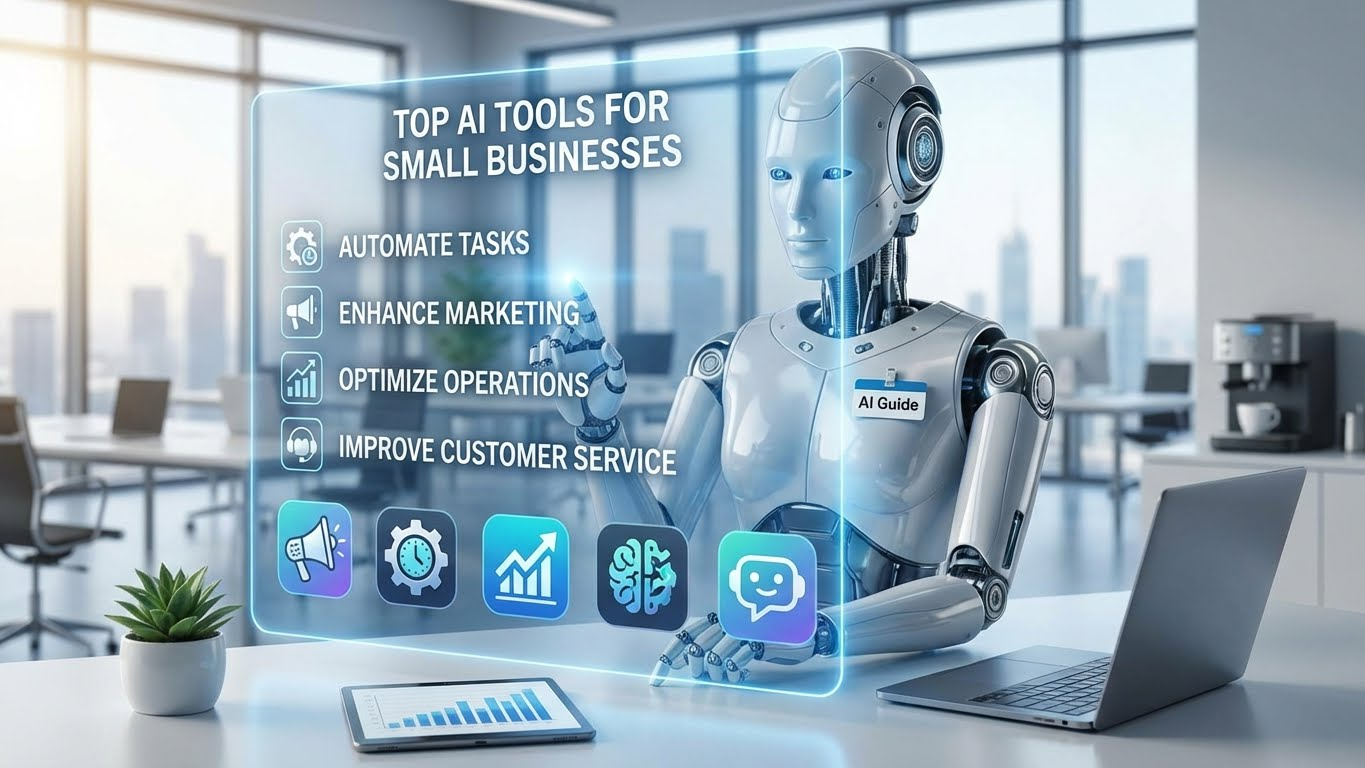
In today’s fast-paced business landscape, small businesses face numerous challenges, from managing time and limited resources to competing with larger companies. Fortunately, AI (Artificial Intelligence) tools are transforming the way small businesses operate by automating repetitive tasks, enhancing customer experiences, and generating valuable insights. This article explores AI tools for small businesses, highlighting their benefits, use cases, and providing practical advice for small business owners.
Understanding AI Tools :
Artificial Intelligence refers to the simulation of human intelligence in machines programmed to think like humans and mimic their actions. AI tools leverage large datasets and algorithms to perform tasks that typically require human intelligence, such as visual perception, speech recognition, decision-making, and more.
Benefits of AI Tools for Small Businesses :
Enhancing Efficiency :
AI tools can significantly enhance operational efficiency by automating mundane tasks. From scheduling meetings to managing inventory, AI can handle repetitive processes, allowing small business owners and employees to focus on more strategic activities.
Cost-Effective Solutions :
Many AI tools provide cost-effective solutions for small businesses. With subscription models and pay-as-you-go pricing, small businesses can access the latest technologies without significant upfront costs, making it easier to integrate AI into their operations.
Improved Customer Experience :
AI tools enhance customer interactions by providing personalized experiences. Chatbots, for example, can answer customer queries 24/7, ensuring that customers receive timely responses and support.
Data-Driven Decision Making :
AI tools can analyze vast amounts of data quickly, providing insights that inform decision-making. Small businesses can leverage data analysis to understand market trends, customer preferences, and operational efficiencies.
Scalability :
AI tools can scale with your business. As your needs grow, AI solutions can adapt without requiring significant additional investments. This scalability can be critical for small businesses looking to expand.
Use Cases for AI Tools in Small Businesses:
Customer Support:
Example: Chatbots and Virtual Assistants
AI-powered chatbots can handle customer queries, manage bookings, and provide support around the clock. For instance, a small restaurant can use a chatbot on their website to take reservations and answer FAQs.
Marketing Automation :
Example: Predictive Analytics Tools
AI tools like HubSpot and Mailchimp use predictive analytics to tailor marketing campaigns based on customer behavior. This can help small businesses send personalized emails, improving engagement and conversion rates.
Financial Management :
Example: Automated Accounting Software
AI tools like QuickBooks and Xero automate bookkeeping and invoicing. These tools help small business owners manage their finances more effectively, reducing the likelihood of errors and saving time.
Inventory Management :
Example: Smart Inventory Systems
AI-powered inventory management systems can predict stock levels based on sales trends. This ensures that small retailers maintain optimal inventory without overstocking or running out of popular items.
Recruitment and Human Resources :
Example: AI Recruitment Platforms
AI tools such as BambooHR or HireVue streamline the hiring process by filtering through resumes, scoring candidates, and even conducting initial interviews. This helps small businesses find the right talent faster and more efficiently.
Comparison Table of Top AI Tools for Small Businesses :
| AI Tool | Features | Use Case | Price Range |
|---|---|---|---|
| HubSpot | CRM, email marketing, analytics | Marketing Automation | $50 – $3,200/month |
| QuickBooks | Accounting, invoicing | Financial Management | $25 – $180/month |
| Chatfuel | Chatbot creation, analytics | Customer Support | Free – $300/month |
| Hootsuite | Social media management | Marketing | $19 – $739/month |
| Trello | Project management | Task Organization | Free – $20.83/user/month |
Practical Advice for Small Business Owners :
Assess Your Needs: Before adopting any AI tool, assess the specific needs of your business. Determine which areas could benefit most from AI solutions, be it marketing, customer service, or financial management.
Start Small: Consider starting with one or two AI tools rather than implementing multiple solutions at once. This will allow you to measure their effectiveness and make necessary adjustments.
Train Your Team: Investing in AI tools is only part of the equation. Ensure your team is trained to understand and use these tools effectively. This will enhance productivity and maximize the benefits of AI.
Analyze and Iterate: Regularly analyze the performance of the AI tools you’re using. Collect feedback from your team and customers to make informed decisions on whether to adjust, upgrade, or replace your AI solutions.
- Budget Wisely: While many AI tools are affordable, ensure you have a budget in place. Factor in any potential hidden costs, such as training and maintenance fees.
FAQ Section :
What are AI tools?
AI tools are software applications that use artificial intelligence to perform tasks that usually require human intelligence, such as decision-making, customer interaction, and data analysis.
How can AI benefit small businesses?
AI can benefit small businesses by enhancing efficiency, reducing costs, improving customer experience, enabling data-driven decision-making, and providing scalability as the business grows.
Are AI tools expensive for small businesses?
Many AI tools are available in various pricing models, including subscription services and pay-as-you-go options, making them quite affordable for small businesses.
How do I choose the right AI tool for my business?
Assess your business needs, research different AI tools, consider features, read reviews, and potentially start with trial versions to find the best fit.
Can AI tools integrate with existing software?
Most modern AI tools offer integration capabilities with popular software applications, allowing seamless integration into your existing systems.
Conclusion :
AI tools present an exciting opportunity for small businesses to enhance efficiency, improve customer experiences, and make data-driven decisions. By carefully assessing your business needs and adopting the right AI solutions, you can streamline operations, save costs, and remain competitive in today’s dynamic market. Remember, the journey into AI is not just about technology; it’s about creating a smarter, more efficient business that can thrive in the digital age. Embrace the future and take your small business to new heights with AI.